

Preparing these cookies requires a bit of a time investment, but they are such a special treat we know you’ll find them well worth the effort.
Hungarian Kiffles (Kiflis) Are A Holiday Tradition
Being of Hungarian descent, kiffles (also spelled kifli) have always been on hand at our family gatherings during the holidays. They take some work to prepare, but one bite will prove they’re well worth the effort.
Kiffles are delicate Hungarian cookies made with cream cheese dough and filled with various flavors of pastry filling. They make a beautiful contribution to any holiday cookie platter.

About Kiffle (Kifli) Fillings
It is very important that you use fillings that are made specifically for pastry in your kiffles. Pie filling will be too loose and jams and preserves can produce unpredictable results.
We’ve always used Solo Brand Cake & Pastry Filling and have never been disappointed. Solo makes a variety of flavors in 12-ounce cans. Pictured here are poppy seed, cherry, almond, and apricot.
Prune (lekvar in Hungarian), walnut, and poppy seed are the most traditional Hungarian choices and if you read through the comments, you’ll see that a few of our readers have included instructions for making these two fillings from scratch.
Pro Tip: How to Make All Your Kiffles the Same Size
Making sure your kiffles are uniform in size is not only about a beautiful presentation, it’s about even baking. The trick is to roll the dough into a perfect 9-inch square. Here’s how to do it:
- Cut a sheet of parchment paper 15 inches wide by 18 inches long. Fold 4-1/2 inches of each short side toward the middle. Make sharp creases and unfold.
- Fold 3 inches of each long side toward the center. Make sharp creases there as well and you should have a well-defined 9-inch square in the center of your parchment paper.
- With the flaps facing up, dust the parchment liberally with flour and place a portion of dough in the center of the square.
- Dust the top of the dough with flour as well, then fold the parchment along your creases to make an “envelope” around your dough.
- Turn it over (flap sides down) and place it on your rolling surface.
- Roll the dough from the center toward the corners as directed above.
- Remove the dough carefully to avoid tearing.
Once you have the dough rolled into a perfect square, you can easily mark off even intervals of 1-1/2-inches (6 per side) with the tip of a knife. Use your pastry wheel to make the cuts and you will get 36 kiffles (kiflis) per square.
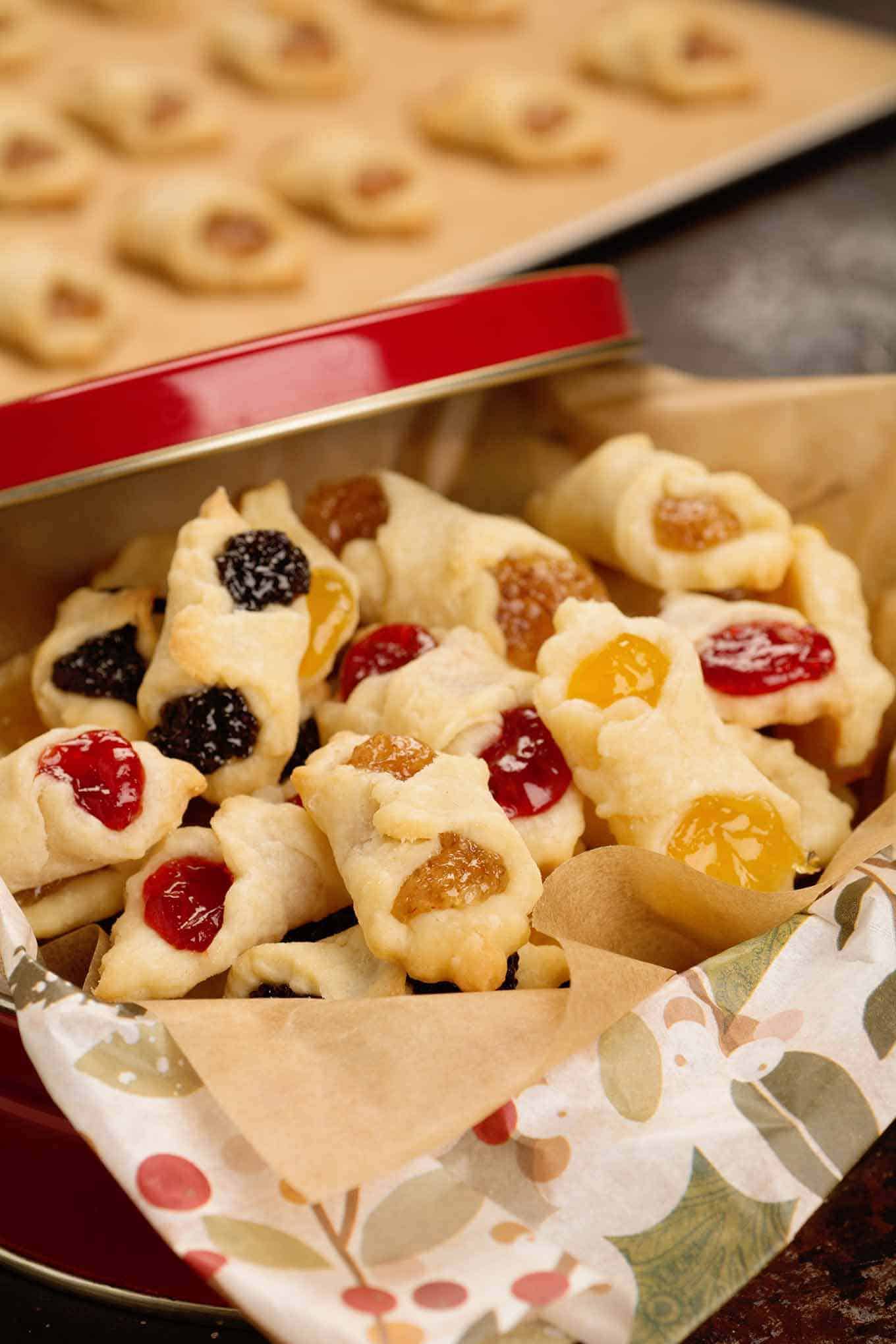

Hungarian Kiffles
Ingredients
- 2-1/4 cups all-purpose flour, plus more for rolling
- 1/2 teaspoon salt
- 8 ounces cream cheese, softened
- 1 cup (1/2 lb) unsalted butter, softened
- 2 to 2-1/2 cups cake and pastry filling, about two 12-ounce cans
Instructions
Prepare the Dough:
- Whisk the flour and salt together in a medium bowl and set aside.
- Beat the cream cheese and butter with an electric mixer on medium speed until very smooth and creamy, 2 to 3 minutes.
- Reduce the mixer speed to low and add the flour mixture, 1/4 cup at a time, mixing just until combined. The dough will be quite moist, but not sticky.
- Turn the dough out onto a lightly floured surface and flatten into a square approximately 1/2-inch thick. Cut into 4 equal pieces and wrap each separately in plastic wrap. Refrigerate until firm, a minimum of 2 hours.
Roll and Cut the Dough:
- Preheat the oven to 375°F and position a rack in the center of the oven. Line a large cookie sheet with parchment paper.
- Remove one portion of the dough from the refrigerator and place it on a liberally floured surface.
- Dust the top of the dough with flour and cover with a sheet of wax or parchment paper. Working from the center toward the corners, roll the dough out to a 1/8-inch-thick square. It should measure about 9 inches.
- For best results, see our recipe notes below to learn how to roll your dough into a perfect square.
- Using a pastry wheel or a sharp knife, cut your dough both lengthwise and crosswise into small squares.
- Your total yield will depend on how large you make them. We recommend 1-1/2-inches which will give you 36 kiffles per square of dough or about 12 dozen total.
- The best way to keep the size even is to use a ruler and mark all 4 sides of the dough square at intervals with the tip of a knife. You can use the handle of a spatula to guide you as you cut to keep your lines straight as well (similar to drawing straight lines on a sheet of paper).
Fill and Seal the Kiffles:
- Working as quickly as possible, place a small mound of filling (about 1/2 to 3/4 teaspoon) in the center of each square. If the filling flavor you’re using is relatively smooth you can spoon it into a small freezer bag, snip off a tiny bottom corner and squeeze the filling onto the squares. This works particularly well with the poppy and almond flavors.
- Lift two opposite corners of the dough over the filling and gently pinch them together. Fold that "point" over to one side, moisten the tip of your finger with a bit of water and smooth it down gently on one side of the kiffle. This prevent the kiffles from popping open as they bake.
- Important Note: The various filling flavors spread a bit differently during baking so you may want to fill a few "test" kiffles and bake them to gauge the right amount of filling for each type.
Bake the Kiffles:
- Arrange the kiffles 1 inch apart on the parchment lined cookie sheet. Bake until barely golden, 12 to 14 minutes. Cool on the baking sheet for 1 minute, then carefully transfer the kiffles to cooling racks.
- Repeat the process with the remaining 3 portions of dough, using different filling flavors if desired.
How to Store Kiffles:
- Store kiffles between layers of waxed paper in a tightly closed container and refrigerate. Bring them to room temperature (30 minutes out of the fridge), arrange on a plate and dust lightly with powdered sugar just before serving. It’s not advisable to top them with powdered sugar before storing.
- Makes 8 to 12 dozen
Notes
How To Roll Your Dough Into a Perfect 9-Inch Square:
- Cut a sheet of parchment paper 15 inches wide by 18 inches long. Fold 4-1/2 inches of each short side toward the middle. Make sharp creases and unfold.
- Fold 3 inches of each long side toward the center. Make sharp creases there as well and you should have a well-defined 9-inch square in the center of your parchment paper.
- With the flaps facing up, dust the parchment liberally with flour and place a portion of dough in the center of the square. Dust the top of the dough with flour as well, then fold the parchment along your creases to make an "envelope" around your dough.
- Place it on your rolling surface, flap sides down and roll the dough from the center toward the corners as directed above. Remove the dough carefully to avoid tearing.


My mom (97 yrs old) got this very same recipe from a friend who discovered that using Lokum (Turkish Delight) cut in small elongated pieces did a good job as a filling. I remember eating these when I was a child.
Hi Dana,
That is really interesting. I have never heard of anyone using Lokum to fill kiffles, but I’ll bet it’s good. I assume it softens during baking, but does it firm up again once it cools?
I’m curious if there’s a way to make these with almond flour? My mom has a gluten allergy so I am always trying to find ways to make her little treats that she can eat.
Hi Ana,
I’ve never tried to make a gluten free version of Hungarian Kiffles, so I can’t speak from experience on this. I don’t know about using almond flour alone, but for the few gluten-free baked goods I’ve made, I have had very good luck with King Arthur Gluten-Free Measure-for-Measure Flour. Most supermarkets carry it, so it’s easy to find. King Arthur also recommends that flour blend for a gluten-free version of rugelach, which has a very similar dough to the kiffles (cream cheese and butter). If you’re wondering about the ingredients, here they are: Rice flour, whole grain brown rice flour, whole sorghum flour, tapioca starch, potato starch, cellulose, xanthan gum, vitamin and mineral blend [calcium carbonate, niacinamide (vitamin b3), reduced iron, thiamin hydrochloride (vitamin b1), riboflavin (vitamin b2).
I just made these with Bobs 1:1 blend. They taste great, but don’t look too nice. They were very hard to work with. The dough was very crumbly, had no elasticity (bc there’s no gluten), & relied heavily on using the heat from my hands to get the butter in the dough to help it stick together.
About halfway through I stopped trying to fold them up & used an upside down silicone cupcake liner to make little discs & just put the filling on top. Tastes great, looks much better.
I will say, if you’re going to fold them, rolling them thicker seemed to help, about1/4in.
Jennifer, our gluten-free contributor is working on a version that uses the King Arthur 1:1 blend and ran into the same issue you did. She’s close to having worked out a solution and we’ll be posting it soon.
my babi used to make these every Christmas great memories. I will keep her memory alive so my family can taste the same cookies I did and the angel wings. I miss those Christmases
Hi Shari,
Sharing old family recipes is a great way to honor the memory of loved ones and start new traditions at the same time. I hope you enjoy!
It is getting very hard to find the solo I use to call the company and they would ship. I tried this year they told me they no longer do that.
Hi Denise,
I’m having trouble finding the Solo Cake & Pastry filling locally as well. You can buy it in 2-packs per flavor on Amazon.com. I can’t attest to how far out the cans are dated as I haven’t ordered any recently.
Poppyseed Filling
1 lb poppyseeds, finely ground
1-3/4 cups sugar
1 egg
Dash of salt
2 Tbsp margarine
1/2 tsp vanilla
Enough milk to make a smooth paste
Combine, cook on low until margarine melted and egg is cooked.
No comparison to the canned with the corn syrup.
Thank you for sharing these recipes, Bonnie! This cookie is just liked what my Hungarian grandma would make when I was a child.
Nut Filling
1 lb walnuts
1 can evaporated milk
1 cup sugar
2 eggs
Bring to a boil over LOW heat, stir constantly when it starts getting hot. I also use this for nut rolls.
Thank you for sharing your homemade kiffle filling recipes Bonnie!
I’m missing something here. Do you chop the nuts? Grind them? What do you do after you boil the nuts, milk, sugar and eggs?
Hi Don,
A more traditional walnut filling would be made by simply combining:
– 2 cups of ground walnuts
– 2 beaten egg whites
– 1/3 cup of sugar
– A pinch of salt
– 1/2 teaspoon fresh lemon zest (optional)
No cooking/boiling involved.
This is the way my mother taught me. She called them angel wings. So good.
This is the way my mother taught me. She called them angel wings. So good.
I’m going to attempt this recipe. My grandma’s is more complicated and she’s not with us our family craves these.
My question to you is you mention wax paper when rolling out do. Is the dough between the floured surface and the wax paper?
Thanks!
Hi Kristen,
Yes, the dough is between the floured surface and the wax paper. I hope you enjoy the kiffles!
I have been making these cookies for years and I can make the following recommendations:
filling: You can also use a high quality raspberry jam by preparing it ahead of time with a small amount of cornstarch; just heat thru until hot and remove from heat and wait until room temperature. This keeps them firm enough so they don”t run while baking.
dough: When sealing together the ends use milk; it works better than water
Walnut or almond filling; use egg whites and sugar beaten to a meringue state then add nuts and stir. Lekvar; prune butter is very hard to find and expensive; You can make your own using prunes and orange juice and water. There are recipes all over the internet.
Happy Holidays!!!
Hi Susan,
Thanks for sharing your expertise. The cornstarch in the raspberry jam is a great tip!