
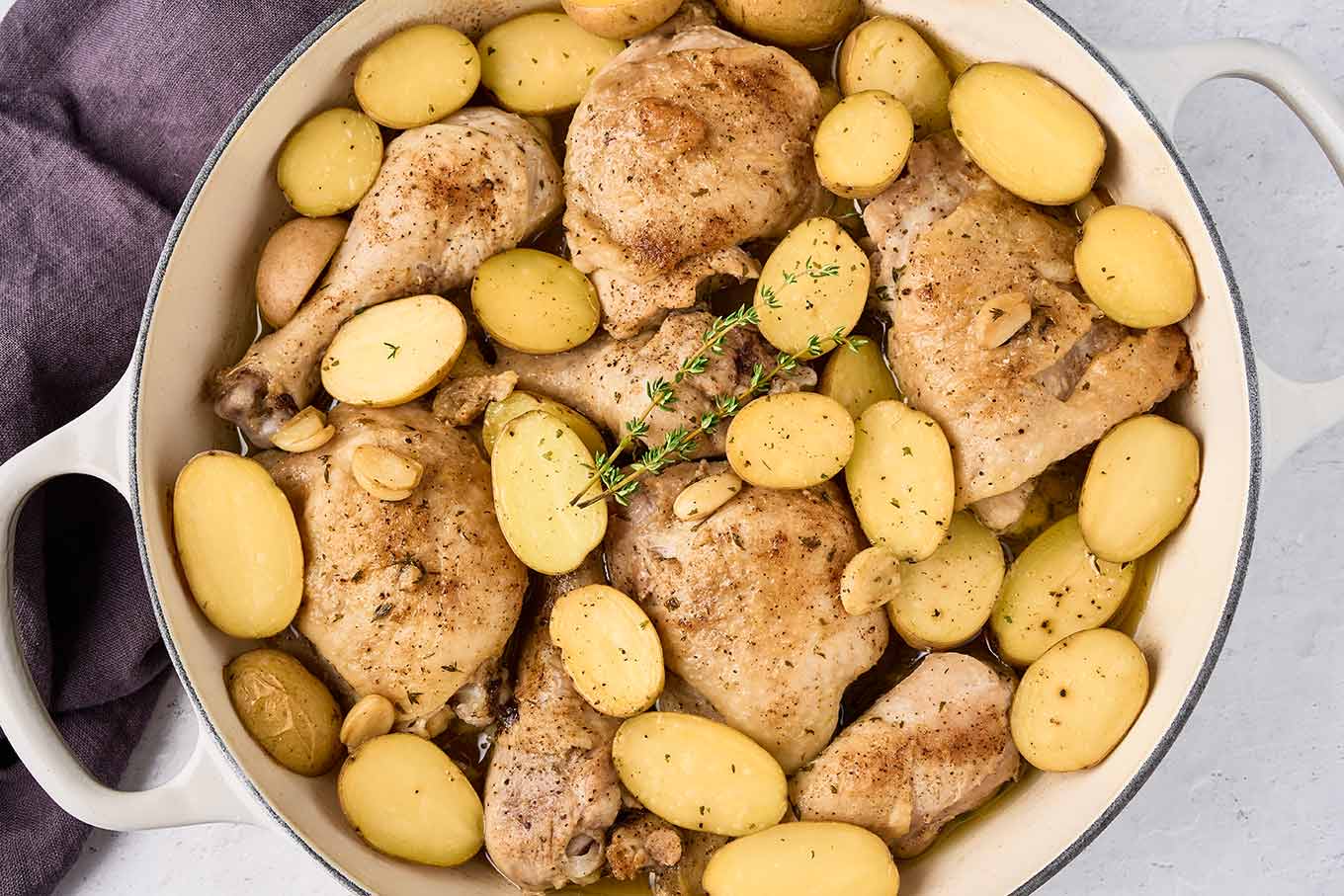
This recipe started as our streamlined take on Chicken with Forty Cloves of Garlic. It has the same mellow garlic flavor, with far less fuss. Instead of cognac or cream, we build the sauce with white wine, chicken broth, fresh thyme, and whole, lightly crushed garlic cloves that mellow as the chicken braises.
Adding baby potatoes to the pan turns it into a true one-dish dinner, and the stovetop-to-oven method keeps everything tender without any hands-on tending. It’s a simple, reliable braised chicken recipe adapted for weeknight cooking. If you enjoy dishes with hearty flavor and straightforward prep, this one should be a keeper.
Ingredient Notes and Substitutions
A few key ingredients make this recipe work – here’s what to know. A complete list with quantities is in the recipe card below.

CHICKEN THIGHS AND DRUMSTICKS: Using a mix of thighs and drumsticks ensures even cooking and makes it easy to nestle everything together in the pan. Bone-in pieces stay juicier, and the browned skin adds flavor. If preferred, you can use all thighs.
WHOLE GARLIC CLOVES: Keep the cloves whole and lightly crushed. This gives the braising liquid its mellow, roasted garlic flavor. Smaller cloves can be used as-is; larger ones can be halved if you’d like a slightly stronger garlic punch.
WHITE WINE: Deglazing the pan with dry white wine after browning the chicken adds brightness. Sauvignon blanc, Pinot grigio, or an unoaked Chardonnay all work well. If you don’t like cooking with wine, substitute an equal amount of chicken broth and add 1 teaspoon of white wine vinegar.
THYME: Fresh thyme holds up well during braising and adds an earthy, savory flavor to the sauce. If substituting dried thyme, use 1/3 the amount (1 teaspoon) and add it early so it fully hydrates.
BABY POTATOES: Small waxy potatoes hold their shape while braising and absorb the garlic-thyme broth nicely. Cutting them in half ensures they cook evenly. You can use larger Yukon Golds, cut into 1-1/2-inch pieces.
A Quick Look at Preparation
How to Make Braised Chicken Legs
Here’s how this dish comes together, along with a few tips for the best results. Full instructions are in the recipe card below.
This dish starts on the stovetop, where browning the chicken builds the base of the sauce. Once the pieces are well-seared, a splash of white wine loosens the browned bits in the pan for added flavor.


The garlic and thyme are softened slightly in the wine before the chicken goes back into the pan. The potatoes tuck in around the pieces, so they soak up the juices as they braise. A splash of broth helps create steam under the lid, keeping the meat tender while the garlic flavor slowly mellows into the juices.

About 45 minutes in the oven is usually right on target for this dish. The potatoes turn creamy, the chicken reaches an ideal tenderness, and the pan juices thicken into a light sauce you can spoon over each portion. Serve with a light green veggie like steamed green beans or sautéed spinach.
Tested Tips
- PAT THE CHICKEN DRY: Before you season and brown the chicken, pat the pieces dry with paper towels. It will brown faster and help build the fond (those flavorful caramelized bits on the bottom of the pan).
- LIGHTLY CRUSH THE GARLIC: Keeping the cloves mostly intact gives you that mellow, slow-roasted, almost sweet flavor.
- USE A PAN THAT’S JUST BIG ENOUGH: A snug fit keeps everything in contact with the braising liquid. This builds rich flavor.
- COOK UNTIL TENDER: Although chicken is safe to eat at 165°F, braised chicken should cook a little longer to achieve that fall-off-the-bone tenderness. Give it the full time in the oven to get that perfect braised texture (internal temp of about 185°F to 190°F).
More Juicy Chicken Recipes
If you like this braised chicken legs recipe, here are a few other comfort food chicken dinners to try. Sheet Pan Chicken with Seasonal Vegetables is a one-pan meal of garlicky honey–balsamic glazed thighs and roasted vegetables; Roasted Boneless Chicken Thighs are coated in a quick balsamic-honey glaze that caramelizes in the oven; and Red Wine Braised Chicken Thighs, os a simplified take on Coq au Vin with mushrooms and pearl onions.
Braised Chicken Legs with Potatoes
Ingredients
- 8 pieces bone-in chicken thighs and drumsticks, (about 2-1/2 lbs)
- 12 cloves garlic
- 1-1/2 teaspoons all-purpose seasoning
- 2 tablespoons olive oil
- 1/4 cup dry white wine
- 1 tablespoon chopped thyme leaves
- 12 ounces baby potatoes, halved
- 1/3 cup low-sodium chicken broth
Instructions
- Preheat the oven to 350°F.
- Lightly crush the garlic cloves, just enough to loosen the skins and release the aroma, then peel and set aside (see recipe notes).
- Pat the chicken dry, then season both sides liberally with all-purpose seasoning (or a mix of salt and pepper).
- Heat an ovenproof sauté pan over medium-high and lightly coat the bottom with olive oil (1 to 1-1/2 tablespoons).
- Add the chicken in a single layer and brown on all sides, 6–7 minutes total. Transfer to a plate and set aside.
- Pour in the wine and scrape up the browned bits (they add flavor). Cook for 1 minute to reduce slightly.
- Reduce heat to medium and add the garlic and thyme. Cook for 2 minutes, stirring continually, just until the garlic softens without browning.
- Push the garlic mixture to one side and return the chicken to the pan, skin-side up, along with any accumulated juices.
- Nestle the potatoes between the chicken pieces and spoon the garlic-thyme mixture evenly over the top.
- Drizzle the broth around the chicken, cover tightly, and bake for 45 minutes, or until the potatoes are tender and the chicken reaches an internal temperature of 165°F.
- To serve, plate individual portions of chicken and potatoes, then spoon garlic and pan juices over the top.
Notes
How To Crush Garlic
- Place a single clove of garlic on a cutting board and place the flat side of a wide bladed knife (chef’s knife) on top.
- Being careful to steer clear of the blade edge, apply hard pressure with the heel of your hand to flatten the clove, then remove the skin which should peel away easily at this point.
Nutrition
Nutrition information is automatically calculated, so should only be used as an approximation.