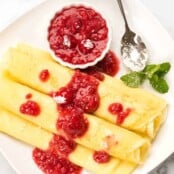
Hungarian Crêpes: Palacsinta
Perfect to serve for dessert or brunch, this recipe for Hungarian-style crepes (palacsinta) has a sweet, lemony cottage cheese filling and a topping of fresh raspberry sauce.
Servings: 6 servings
Ingredients
- 3 large eggs lightly beaten
- 1-1/4 cups whole milk plus more if needed
- 3 tablespoons butter melted
- 1/4 teaspoon salt
- 1 cup all-purpose flour plus more if needed
For the filling:
- 2 cups cottage cheese (not reduced fat)
- 1/4 cup confectioners' sugar
- Zest of 1 lemon
- 1/2 teaspoon vanilla extract
For the raspberry sauce:
- 2 cups fresh raspberries washed and well drained
- 1 tablespoon freshly squeezed lemon juice
- 1 tablespoon sugar
- 2 tablespoons water
- 2 teaspoons cornstarch
Instructions
- In a medium mixing bowl, whisk together the eggs, milk, melted butter, and salt. Whisk in the flour 1/4 cup at a time until the mixture is free of lumps and thoroughly combined. Cover and refrigerate for at least one hour to allow the batter to thicken.
- While the batter chills, make the filling and the raspberry sauce. For the filling, combine the cottage cheese, confectioners' sugar, lemon zest, and vanilla in a bowl. Cover and refrigerate until ready to use.
- To prepare the sauce, place the raspberries, lemon juice, and sugar in a small saucepan and bring to a simmer over medium-high heat. Whisk the water and cornstarch together in a small bowl until well blended, then add to the raspberry mixture. Return to a simmer and continue cooking until the mixture thickens to a syrup-like consistency (do not overcook). Transfer to a bowl and set aside to cool.
- To make the palacsinta, add 1 teaspoon of vegetable oil to a 10-inch nonstick pan and rub it over the bottom and sides with a paper towel. Heat the pan over medium heat and add 1/4 cup of the batter to the center of the pan. Working quickly, lift the pan from the heat, tilting and rotating until the batter coats it completely in a thin layer.
- As soon as the crêpe appears set and "dry" (20 to 30 seconds), flip it over and cook until barely browned, 10 to 15 seconds longer. Transfer to a plate and repeat with the remaining batter.
- Stack the cooked palacsinta (crepes) on a plate. You should end up with about 1 dozen.
- To serve, place one crêpe on a flat surface and spread about 2-1/2 tablespoons of the filling on one side, about 1 inch in from the edges. Gently roll the crêpe to form a tube, making sure the filling is evenly distributed. Place seam side down on a serving plate and top with raspberry sauce.
Notes
Five Tips for Making Perfect Crêpes (Palacsinta):
Making crêpes is an inexact science at best and it does take a little practice to get comfortable with the process. Here are a few tips to help you make a successful batch, even if it's your first time making them.- Always let the batter rest for at least 1 hour, then whisk again just before cooking to ensure there are no lumps. You can make the batter up to a day ahead if you like.
- Using a true, nonstick pan really helps. We generally use a 10-inch size, but an 8-inch works too. Just reduce the amount of batter you add for each crêpe to 3 tablespoons. You'll get 4 to 6 more crêpes using the smaller sized pan.
- The first crêpe you make will help you judge the batter consistency. If it is too thick, it will be hard to get the batter to spread to the edges of the pan before it sets. Whisking in an additional 2 to 3 tablespoons of milk should help. If the batter is too thin, the first crêpe will become dry and brittle as it sets. It that's the case, whisk in a little additional flour (1 or 2 tablespoons at most).
- As soon as the batter begins to dry around the edges and appears set, use a thin spatula to get under the crêpe and flip it quickly. Don't worry if it doesn't land perfectly flat after flipping. You should be to straighten it out easily enough.
- You can put a layer of wax paper between the cooked crêpes if you like, but we don't bother and have never had an issue with them sticking together, even when made ahead and stored overnight.
Nutrition
Serving: 2crepes | Calories: 288 | Total Fat: 12g | Cholesterol: 121mg | Sodium: 403mg | Carbohydrates: 31g | Fiber: 3g | Sugar: 11g | Protein: 14g